Cruise
Banff: Lake Minnewanka Cruise
Sails early May – Thanksgiving Monday in October. Online sales reopen before the season; until then, see the tours that include the cruise.
StoriesHistory · the drowned village · diving
Yes, there really is a town under the lake. The Lake Minnewanka ghost town is Minnewanka Landing, a summer resort village that grew up from the late 1880s and was drowned completely when Calgary Power's dam raised the lake in 1941. Its foundations, wharves and sidewalks still lie about 15–25 m down at the west end, the same end the cruise leaves from.
Updated October 19, 2026Facts checked against Parks Canada and operator sourcesContains partner links
Sails early May – Thanksgiving Monday in October. Online sales reopen before the season; until then, see the tours that include the cruise.
Nothing matches this filter.
See all on GetYourGuide →Prices from GetYourGuide, checked October 19, 2026; they change with date and group size.
Lake Minnewanka is a natural glacial lake that has been dammed three times, and today it is a hydroelectric reservoir, the largest lake in Banff National Park. By 1912 its west shore held Minnewanka Landing, a resort village of four avenues and three streets with hotels, restaurants, wharves and tour boats. A dam in 1912 flooded part of the village. The 1941 dam finished the job.
Nothing about it is spooky. "Ghost town" is a media label for a flooded resort, and it stuck because it makes a good headline. Divers can see what is left; everyone else gets the story on the one-hour boat tour, where the guide covers the village and the dams.
The name comes from the Stoney Nakoda language. Parks Canada gives it as Minn-waki, "Lake of the Spirits"; the Stoney Nakoda Nations translate it as "sacred waters". Parks Canada writes that the Stoney "respected and feared" the lake for its spirits. Early Europeans went the other way and called it Devil's Lake.
Lake Minnewanka lies in Treaty 7 territory, the traditional lands of the Stoney Nakoda (Bearspaw, Chiniki and Goodstoney First Nations), the Blackfoot Confederacy (Siksika, Piikani and Kainai) and the Tsuut'ina. The name and story of this lake are Stoney Nakoda, and the Stoney Nakoda Nations are living nations with their own voice on it.
People have camped and hunted along these shores for more than 10,000 years, and archaeologists have dated campsites here to about 13,000 years ago. The finds include hearths, mountain-sheep bones, red ochre and stone tools, on old shorelines near where the Cascade River once flowed out of Stewart Canyon into the lake. Most of that ground is underwater; part of it is exposed each early spring when the reservoir is low. It is a protected archaeological site: look, don't dig, don't pocket anything.
At the far east end, Devil's Gap, a glacier-cut gap where the mountains open to the prairies, is described as a historic Nakoda route between the plains and the mountains. When the 1941 dam was built, the clearing of the future lakebed was contracted to Nakoda band members.
Minnewanka Landing was a summer resort village that grew up on the west shore from the late 1880s. Some sources say 1886, others 1888; anyone who says it was founded in 1912 has confused the village with the dam that started to drown it.
The first building was the Beach House, a log hotel. By 1912 the village had four avenues and three streets, more than one hotel, wharves, restaurants and tour boats with the period-perfect names Lady of the Lake and Daughter of the Peaks. The sightseeing cruise, in other words, is not a modern invention.
That is also why "abandoned town" misleads. This was a summer resort, not a mining town, and nobody abandoned it in a panic: the water came up in two stages, by design.
The water you see is not the lake the Beach House guests saw. Three dams made it, and many websites mix up who built which.
You will see exact figures for the 1941 raise quoted with confidence (30 m, 100 ft, 60 ft). The sources disagree, so we stick to "roughly 20 to 30 metres".
The reservoir is still run for power. TransAlta controls the water, which leaves through the dam toward Two Jack Lake and on to a power plant on the Bow River, and the level drops by up to about 5 m between spring and autumn. When you drive across the dam on the Minnewanka Loop, you are crossing the 1941 project.
The lake is more than 140 m (460 ft) deep at its deepest, but the history sits in the shallower water at the west end, nowhere near the bottom. Most of it lies about 15–25 m down; the village area is about 18–25 m when measured in autumn, at low water.
What is down there, in plain terms:
Visibility varies with the season and the number of divers, and none of it can be seen from the surface.
Where the old village lies
Map data © OpenStreetMap contributors (ODbL). Simplified; not for navigation.
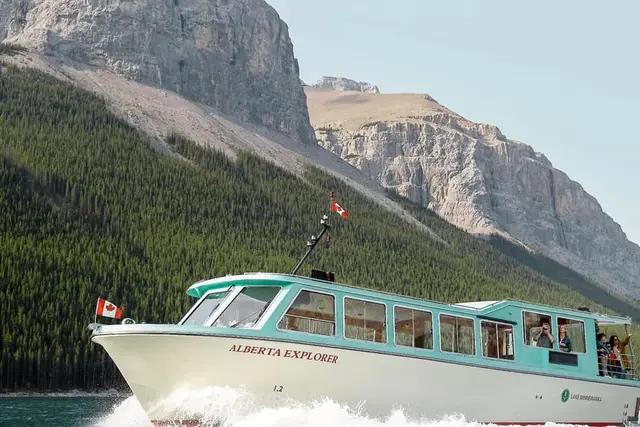
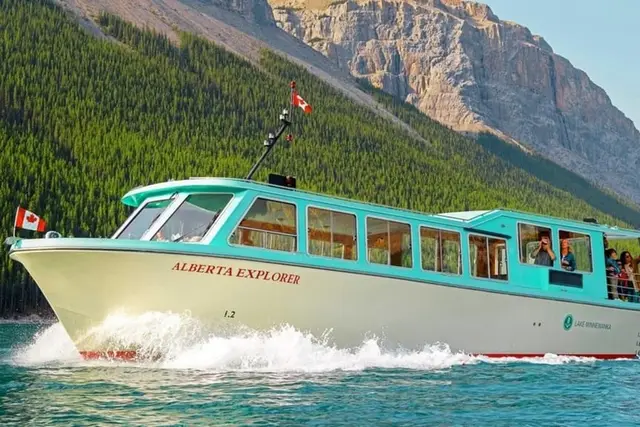
You don't need to dive. The Classic Cruise runs about 1 hour, including the safety briefing and boarding, and its guide's commentary covers Stoney Nakoda history, geology, wildlife, Minnewanka Landing and the dams. The boat heads east from the west-end dock toward Devil's Gap, then turns back, with no landing ashore. It currently costs from about $80 plus GST per adult (about $84 with GST), in CAD, and in season you can check dates for Lake Minnewanka cruises on GetYourGuide.
The cruise runs from early or mid-May to Thanksgiving Monday in October only, weather permitting; outside those months there is no boat. Booking opens about 90 days ahead, and the cruise guide has the details. Many day tours stop at the lake, such as the Lake Minnewanka Cruise, Gondola & Top 3 Lakes Tour from about $95, but check whether the cruise ticket is included in the listing: on most third-party tours it is optional and at your own cost, and off-season they swap the cruise for other stops. The day tours guide sorts out which is which.
On foot, the history is on the interpretive panels by the day-use area. The easy Stewart Canyon walk, about 1.5 km each way from the lakeside trailhead, ends at the canyon where the Cascade River enters the lake, close to where people camped thousands of years ago; the hikes guide has the details. Both are free with your park pass, and the lake is 15–20 minutes from Banff by car, or about 25 minutes on Roam Route 6 in summer (getting there).
Sails early May – Thanksgiving Monday in October. Online sales reopen before the season; until then, see the tours that include the cruise.
See all on GetYourGuide →Prices from GetYourGuide, checked October 19, 2026; they change with date and group size.
With three hours at the lake, do the Classic Cruise and the Stewart Canyon walk (about 1 hour return). With half a day between June and October, add Bankhead (below) on the drive back, and you will have covered most of the lake's human history from 13,000 years ago to 1941 without getting your feet wet.
Lake Minnewanka and Two Jack Lake are the only places in Banff National Park where you can scuba dive. Parks Canada publishes a dive-site list for the village, the 1912 dam and the bridge.
Before a dive at Lake Minnewanka
Two Jack Lake next door, covered in things to do, also allows private paddling with the same permit. Lake Minnewanka does not: private canoes, kayaks and paddleboards are banned, and the on-site rentals are the way to paddle.
A flooded village on a "Lake of the Spirits" was always going to collect stories. Some fall apart on contact with the record.
| Claim | Verdict | What's true |
|---|---|---|
| The lake is haunted | Myth | There is no documented haunting. The reputation comes from the "Lake of the Spirits" and "Devil's Lake" names, plus a lot of video channels. |
| A whole ghost town lies under the lake | Partly true | A summer resort village, not a mining town; foundations, cellars, wharves and sidewalks remain, not standing buildings. |
| Bankhead is under the lake | False | Bankhead is a separate coal-mining ghost town, on dry land beside the Minnewanka Loop. |
| A merman was caught in the lake | False | The Banff Merman is a taxidermy curio in a Banff shop, with no connection to the lake. |
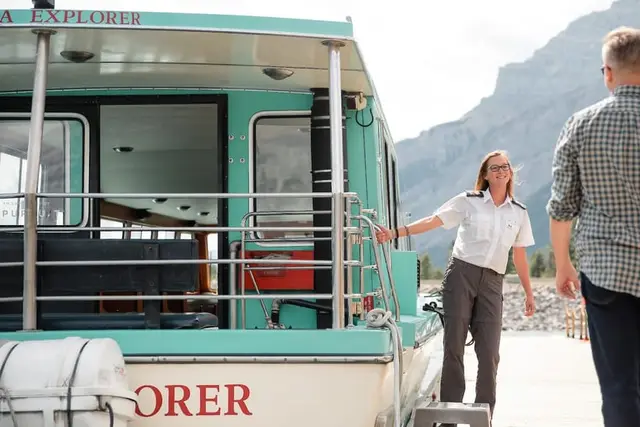
One story genuinely is told about the lake: of a spirit creature, part fish and part human, living in its waters. It is a story, not a sighting, and we pass it on as that. The family Junior Explorer cruise leans into the fun side, with tales of local characters and "lake monsters".
The Banff Merman is something else entirely: a taxidermy curio in a Banff shop, with no link to the lake and none to Stoney Nakoda tradition. Anyone selling it as a Minnewanka legend has merged two unrelated stories.
Many people searching for an "abandoned town" at Lake Minnewanka actually mean Bankhead. Bankhead was a coal-mining town on the Minnewanka Loop, opened in the early 1900s and abandoned in 1922; its ruins are on dry land along the Lower Bankhead trail. Bankhead also had a steam power plant that served Banff, which is how its closure led to the 1923 power-plant houses now under the lake.
The Lower Bankhead trail is an easy loop of about 1.1 km with about 70 steps, and takes 30–45 minutes. From Upper Bankhead, the C-Level Cirque trail (3.8 km one way, 440 m of climbing, about 3 hours return) passes old mine workings.
One catch: the western section of the Minnewanka Loop, the Bankhead side, is closed to cars from November to May to protect a wildlife corridor. The lake stays reachable from the eastern side, past Two Jack Lake; Bankhead does not.
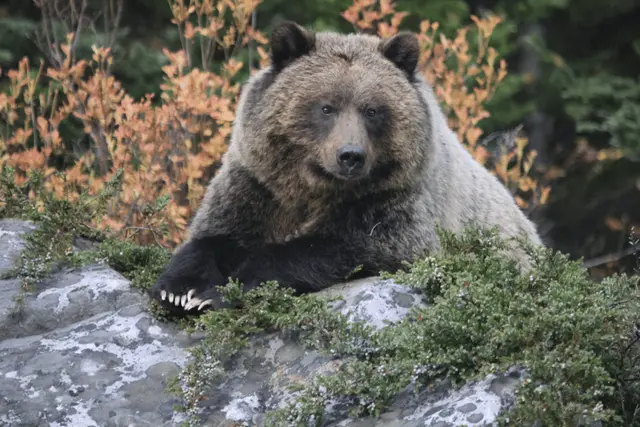
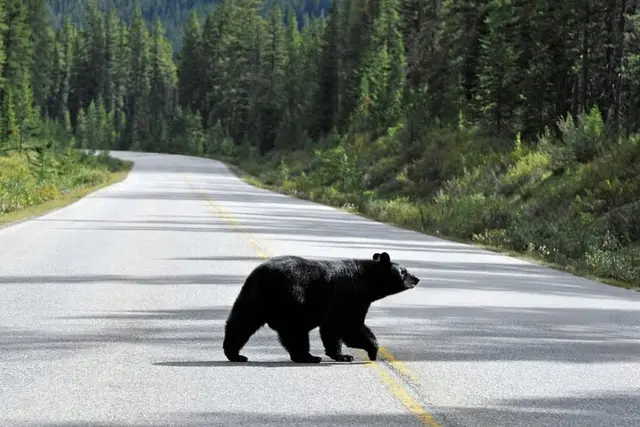
The village is gone; the animals are not. Bighorn sheep are often on the road above Two Jack Lake, and elk, mule deer, black and grizzly bears, wolves, coyotes, bald and golden eagles, loons and osprey all use the valley, which lies on a golden-eagle migration route. From the cruise, bighorn sheep, bald eagles and occasionally bears and wolves on the slopes are possible, never guaranteed.
Parks Canada asks you to stay at least 30 m (three bus lengths) from deer, elk, sheep and moose, and at least 100 m (ten bus lengths) from bears, wolves, cougars and coyotes, on foot, bike or in a car. Elk can be aggressive in late spring (calving) and autumn (the rut).
Bears shape the trails here. Every year from July 10 to September 15, beyond the Stewart Canyon bridge, you must hike in a group of at least four, stay within 3 m of each other and carry bear spray, with no bikes or dogs past the bridge (Parks Canada). The reason is grizzlies feeding on buffaloberries along the north shore. The Stewart Canyon walk up to the bridge stays open to everyone, and Parks Canada closes the lakeside trail at short notice when bears are active, so check its bulletins. Carry bear spray on trails; it is not allowed on the cruise boats.
To let someone else do the spotting, try the small-group Banff Highlights & Wildlife tour (from about $190) or the cheaper wildlife and sightseeing minibus tour (from about $89). After dark, the Lake Minnewanka stop and Two Jack Lake stargazing tour, from about $142 from May to October, starts with a guided walk by this shore; the helicopter and stargazing guide covers the lake from the air and at night.
See all on GetYourGuide →Prices from GetYourGuide, checked October 19, 2026; they change with date and group size.
Yes. Minnewanka Landing, a summer resort village on the west shore from the late 1880s, was partly flooded by a dam in 1912 and drowned completely by Calgary Power's 1941 dam. Its foundations, cellars, sidewalks and wharves lie about 15–25 m down.
No — the lake is natural, but dams have made it much bigger and deeper. Dammed in 1895, 1912 and 1941, it is today a hydroelectric reservoir.
No. The ruins lie about 15–25 m down in cold water. The cruise guide tells the story of Minnewanka Landing and the dams, and the only way to see the remains themselves is to scuba dive.
Yes, with Parks Canada's free aquatic invasive species self-certification permit for your gear. The dives are cold, at altitude and mostly deeper than 14 m, for experienced divers only, and there are no guided dives to book.
There is no documented haunting. The idea comes from the names: Parks Canada gives the Stoney Nakoda name as Minn-waki, "Lake of the Spirits", and early Europeans called it Devil's Lake.
More than 140 m (460 ft) deep at its deepest. The drowned village sits much shallower, about 18–25 m down when measured in autumn, when the reservoir is low.
Cookies & booking calendars Our pages are cookie-free, but the GetYourGuide booking calendars load from GetYourGuide and may set their own cookies. Details